

The Designers Who Bet Their Wedding Money on a Pair of Jeans
Still Here's Sonia and Maurice Mosseri turned a pair of their father's patched-up Levi's into one of New York's most coveted denim brands.


Good morning, friends!
First, Louise Trotter’s first collection for Bottega Veneta is now available to shop online. There are toothsome resin earrings, a plucked and feathered Andiamo clutch, and loads of ooey gooey suiting that contrasts beautifully with the collection’s sharp foot and eyewear. And while we’re on the topic of capital-I Important Female Designers, Phoebe Philo dropped more of Collection D yesterday, though I still don’t see the plaid pieces or fuzzy coats still to come.
The Love List has long celebrated and elevated female designers, but we have a sweet spot for the scrappy, independent women leading their own charge. My bloodhound nose for that kind of gal led me to Sonia Mosseri of buzzy NYC denim brand Still Here, which she co-founded with her husband Maurice. The couple are Brooklyn-born high school sweethearts who funded their first production run with their wedding gift money—$20,000—and built the brand into an eight-figure business without a dollar of outside funding. Still Here launched in 2019 with an exclusive at Barneys (RIP), and has since opened three of its own stores in New York: Nolita, Madison Avenue, and Williamsburg.
The origin story is a good one: Sonia’s father, an Egyptian-Jewish immigrant who came to the U.S. to escape persecution, wore a single pair of Levi’s through a decade of school, patched up by her grandmother every time they ripped. He eventually passed them down to Sonia, and that pair became the founding obsession. Every Still Here jean is 100% cotton—no stretch, no synthetic fibers—designed in New York, hand-finished in LA, and built to break in over time.
Jeans retail from $235 to $280, with hand-painted styles up to $425. Taylor Swift, Kaia Gerber, Hailey Bieber, and Emma Chamberlain have all worn them. I sat down with Sonia and Maurice to talk about building a brand on instinct, what most denim companies get wrong, and why 100% cotton is a hill they’re willing to die on.




Jess Graves: Denim is one of the most emotionally loaded categories in fashion. What was your original relationship to denim before you ever thought about starting a brand?
Sonia Mosseri: My father gave me his childhood jeans when I was younger as a memento from his childhood. His family immigrated from Egypt to New York when he was 7 with little to no belongings. My grandmother got him a pair of jeans for school, told him to size up (to last longer!), and he wore them throughout his youth. They have a ton of memories engrained in them: ink stains, patches hand sewn on by my grandmother, etc.. They’ve been in my safe forever, but are now hanging at our Williamsburg store. This jump-started my love for jeans, as they are one of the only garments that get more valuable with wear. They capture time and memory.
Since getting this pair as a gift from my Father, I amassed an extensive vintage jean collection (most of which I painted on and sold at the start of Still Here). It was my hunt - my sport!
On a more personal level, my relationship with wearing jeans and a white t-shirt was always a crutch between different phases of my personal styling. When I would hit a lull in inspiration, I would always revert to this timeless “American Uniform”. This was an eye-opening realization that ultimately served as one of the impetuses for starting Still Here.
JG: You’re a couple and creative partners. What does your collaboration look like day-to-day, and where do your instincts most naturally diverge?
Maurice Mosseri: Sonia and I each have distinct core strengths, but having been together for so long, we also share a unified vision for both the brand and the business. Early on, that overlap created daily friction, so we quickly realized we needed clearly defined focuses to avoid stepping on each other’s toes. Today, Sonia leads all creative and brand direction, and I oversee all things operationally on the business side. We collaborate closely almost daily on strategy. Beyond being a visionary creative, Sonia is an exceptionally sharp business person.

JG: How do you think about growth without diluting what made Still Here feel special in the first place?
MM: It’s really difficult to scale a brand and hold onto those elements. I often talk about the natural tension between Brand and Business, and that our goal should always be to strike a healthy balance between the two. Brand, in this context, is all things that help grow our allure and mystique, but don’t necessarily generate any amenable ROI / any money, and “business” is the exact opposite- it’s a focus on optimizing for sales growth and the capitalist agenda that comes with that. The only way I believe you can do this effectively is to apply this filter to all major decision-making. If it helps the business more than it helps the brand, you need to reinvest in the brand; vice versa. It’s a balancing act that proves even more difficult when you’re self-funded and cash flow the business entirely.
JG: You’ve expanded beyond jeans into ready-to-wear. What told you it was time, and how did you decide what Still Here tops, layers, and silhouettes should look like?
SM: After building our jean business for a few years, we realized our customers were also interested in the pieces we were pairing with the jeans. We’d very often get asked, “Great jeans, and where is the top from?” We saw a clear appetite for expansion into other categories as our community wanted more from us. We think about category expansion more as context than the main character. We are and always will be a jeans company first. The ready-to-wear pieces are incredibly fun to design, style with, and dress our girl from head to toe.
The approach to design is “Everyday Dressing” - a term we use daily. It is a collection of clothing you can wear daily and in a dynamic way. Following that philosophy, we launched Colors, our basics line, two years ago. We describe Colors as a “Dressing System”: a group of basics that can be worn together or separately, the perfect tops to pair with jeans.
Each fit is released in limited runs of different colors that we call Chapters. It is inspired by a good tee stack in anyone’s closet or at a vintage store. As we release each Chapter, we watch our customers’ “Stacks” grow taller (and they’re each so personal in their color assortments).
The response to Colors has been incredible, and building it alongside the jeans has been seamless. (Chapter 4 is a long sleeve thumby shirt - perfect for layering - available on 2/26 at 11 am ET on stillhere.nyc and in our NY stores.)

JG: Denim brands often live or die by fit. What’s your philosophy when it comes to designing jeans that women actually want to live in?
SM: I design butt first. I think at the end of the day, when a woman puts on jeans, it’s the first thing she checks. But there are so many elements to designing jeans, and I am super fussy about the fit. That is why we don’t often release new fits. I believe there can be a finite amount of jeans in a person’s closet, and we’re taking up time releasing them. Aside from fit, hand-feel is super important. I like the feeling of substantial heavy weight 100% cotton jeans. I think a person feels a garment like that and immediately says - “yeah, those are to do life in.”
JG: Becoming new parents while running and growing a fashion brand is no small thing. How has parenthood shifted your priorities — creatively, emotionally, or operationally?
SM: We are so damn in it right now. Parenthood keeps us in check. It is both exciting and extremely challenging to build a family and a business at the same time. We have insane days at work running this very different sort of fashion start-up, then come home to what feels like 3 more start-ups (ha!). On most days, I leave work a bit early, go home for dinner, a bath, and bedtime, and once the kids are asleep, I’ll be online working until late. It is crazy. I’ve gotten better at it as the team has grown, thankfully, but it truly feels like there are not enough hours in the day. Ever.
Creatively and emotionally, parenthood keeps me light and whimsical. I think it allows me to hold on to my silliness, even on a hard day. It allows me to hold on to perspective at times when work feels overwhelmingly scary. And it humbles me every day. I am so grateful.
JG: Has having a child changed how you think about legacy — both personally and for the brand?
SM: It isn’t an easy thing to leave your kids to go to work. Especially for me, I was lucky to be raised by such an incredible Mom who gave me so much ‘Mom time’. She worked from home part-time and dedicated her life to my sisters and me, so I am doing it very differently from how I was raised. I deal with a lot of Mom guilt because of it. So I often revert to this thought of legacy and the idea that one day I will have the perspective that it will all be worth it; that my kids will be so proud of what their parents built. Immediately, I hold onto the idea that my kids are watching their parents work really hard, and that is so valuable.

JG: What does “success” look like to you right now, as opposed to when you first started Still Here?
MM: For the first six years of Still Here, we were in pure survival mode. We knew almost no small brands make it in this industry- especially without outside capital, real infrastructure, or any prior experience. So it was just day-to-day (and night) grinding and learning everything the hard way. Back then, success was simply not feeling like we might disappear completely in three months. Paying myself a modest salary felt like a huge success. A celebrity organically wearing the brand felt like success. Breaking a major luxury retailer or even just investor interest all felt validating.
Today it’s different for sure. Getting from zero to one was incredibly satisfying, but now success looks like building the brand to its full potential without losing that special spark or ourselves in the process. Elevating Still Here in a way that’s organic and disciplined, while also being a present spouse, parent, and friend, and making space for personal interests. Balance now feels like a real win. Building something truly meaningful without it coming at the expense of everything else feels like success to me today.
JG: When you imagine Still Here five years from now, what do you hope feels exactly the same, and what do you hope has evolved?
MM: At the consumer level- I hope the feeling of finding your perfect jeans never goes away. Internally, I hope it always feels this exciting, fun, and holistic to be building every day. At the same time, in 5 years, I’d hope to see the brand capture more market share in multiple categories. I’d also hope to see the business evolve in a healthy way, incorporating a stronger structure that we can continue to build on.
JG: How would you describe your design ethos? If someone raided your closet, what story would they piece together about your life?
SM: I dress pretty classically and comfortably — it has to work for building Still Here in New York and being a mom. Nothing feels loud, but there’s always a detail that makes it personal. Most of what I wear is vintage or heritage American pieces I’ve collected over the years, mixed with Still Here. Lots of good layers, shapes, colors and classic fabrics (wool, silk, etc..). In the winter, I love a special hat; in the summer, it’s a staple flip-flop and a puka shell necklace. It’s easy, but never accidental.

JG: What’s in your cart right now?
SM: The Row’s Marcel bag, this baby mobile, a sterling silver ruler charm, a meadow phone, a grey Thurston hat, this vintage stool, a rock tumbler, Alaia sandals, a Richard Diebenkorn book, these Gaetano Sciolari lamps, more glass Ikea containers, this insane cup (I love cups), Hywl perfume - my signature scent!
JG: What was the last piece of culture (book, film, meme, essay, anything) that felt like a breath of fresh air?
SM: I just watched “Train Dreams”, and it was incredibly moving. Makes me want to go off the grid. Also pretty deep into the Steve Jobs book, which has absolutely changed my life as a creative person. And I swear by Hunt Gather Parent - on the parenting side of things.
MM: “Sentimental Value” was my type of film. I read a lot of nonfiction and behavioral finance books, but especially loved The Art of Spending Money by Morgan Housel, which is cleverly pretty much the opposite of what its title suggests (I had to remove the book cover to read in public).
JG: What’s on your playlist right now?
MM: Donnie & Joe Emerson, Shuggie Otis, Drugdealer, SAULT, ASAP Rocky, MF Doom
SM: Khruangbin, Fred Again, King Krule, Geese, LCD Soundsystem, Eliot Smith!
JG: What’s the fashion archive piece you’re always hunting for but haven’t found yet?
SM: I am always on the hunt for the elusive “top” you can wear to dinner, or to a party - I end up buying more button-downs or blazers, which do not check the box. It’s a bad cycle.
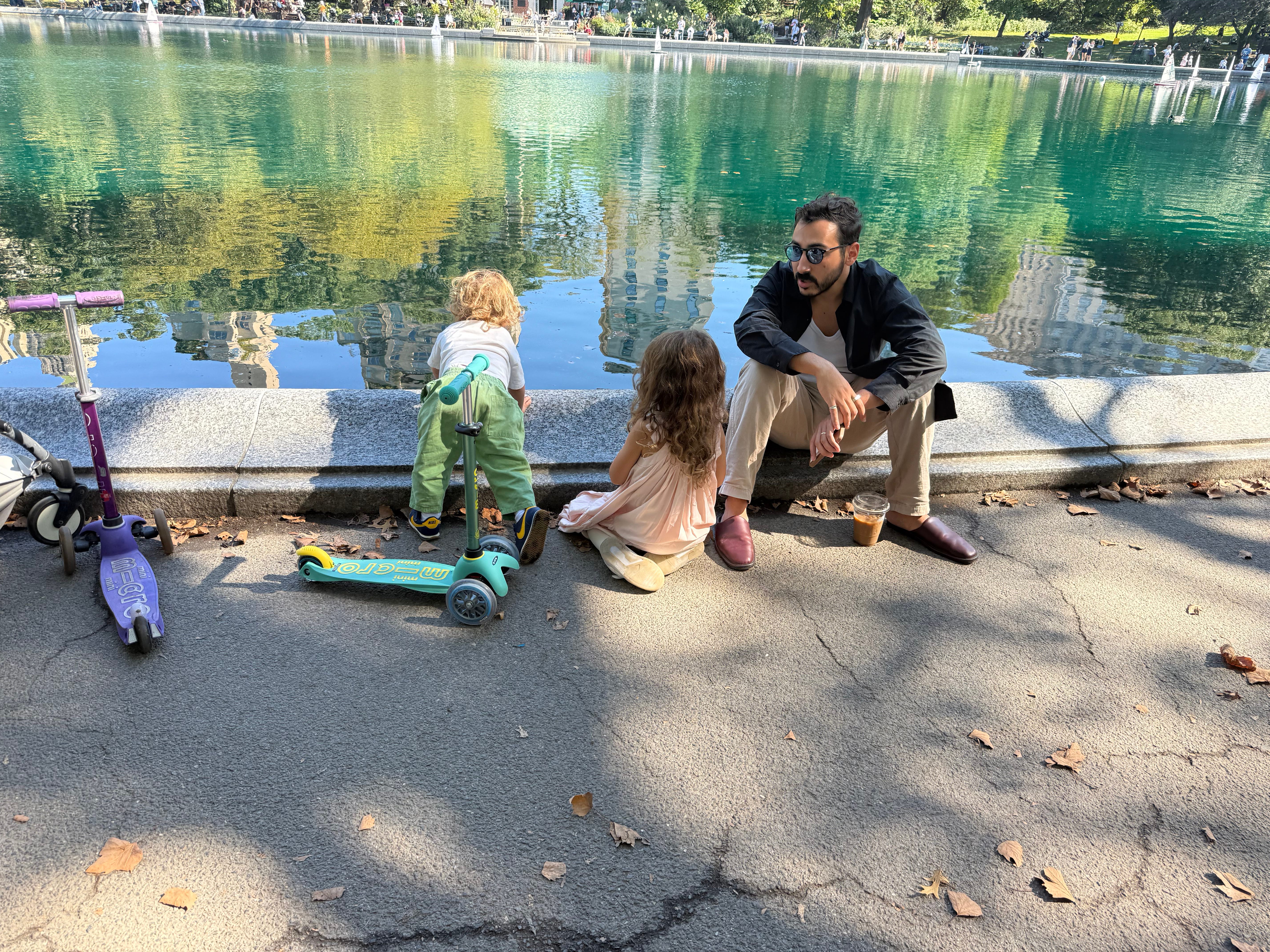
JG: Describe your perfect Sunday.
SM: If I can drink my coffee in the morning hot without having to microwave it multiple times, Pizza store for lunch, Central Park with the kids scootering around the pond, us adults people watching and getting sun, hit a vintage or antique store, early dinner at home, movie, and a cold Arak with Maurice, asleep before 10.

Omg their story is 🥹🥹🥹 I had no idea! Makes me love Still Here even more. I’m so impressed by what they’ve built
LOVE them and their brand