

This Runway Could Have Been an Email
On the back nine of NYFW, a case for self-awareness.

Allow me to correct myself: it’s not simply that the girls are “back.” It’s that we finally remember we’re the clients. And I don't know any client who is going to buy what we saw at Calvin Klein. I can’t even talk about it except to say that it was rage bait — a runway that should have been an email.

By the time I reached the back half of the week — FFORME, Kallmeyer, Heirlome, and finally KHAITE — the message felt clearer. These designers can make clothes that meet us where we actually live. Which raises the real question: why would we accept less?
We are the ones buying the coats. We are the ones deciding which brands enter our closets and which get left on the rack. If we want depth instead of gimmicks, proportion instead of provocation, intelligence instead of click bait — we have leverage.
New York, at its best, designs for women with places to be. So let’s demand that the clothes respect our time, our money, and our bodies!
Fashion shows can feel like sealed, sterile rooms. Controlled guest lists. Velvet ropes. A choreography of who sits where and who gets photographed with whom. It’s easy to forget, in that hush of exclusivity, that the women not in the room are the ones who keep the lights on, and that woman is you.
The clients in Chicago and Dallas and London. The women reading this on their phones between meetings. The ones who save, invest, and read Substack before they shop! Brands may stage the spectacle for a few hundred insiders, but they survive because of the thousands who never saw the runway in person. The room isn’t the seat of power, y’all! The customer is!!!
When designers recalibrate, it’s often because the market has quietly pushed them to. Under Frances Howie, FFORME is successfully loosening up. This is her second full season at the helm after Paul Helbers’ departure, and you can feel the recalibration. Early FFORME was pure architecture: austere columns, almost monastic restraint, an intellectual minimalism. Nina Khosla founded the brand on that idea: precision, purity, and form first. And it made sense at the peak of the “quiet luxury” boom. The bones are still there. But Howie is now introducing sex, flesh, tactility, and delight.
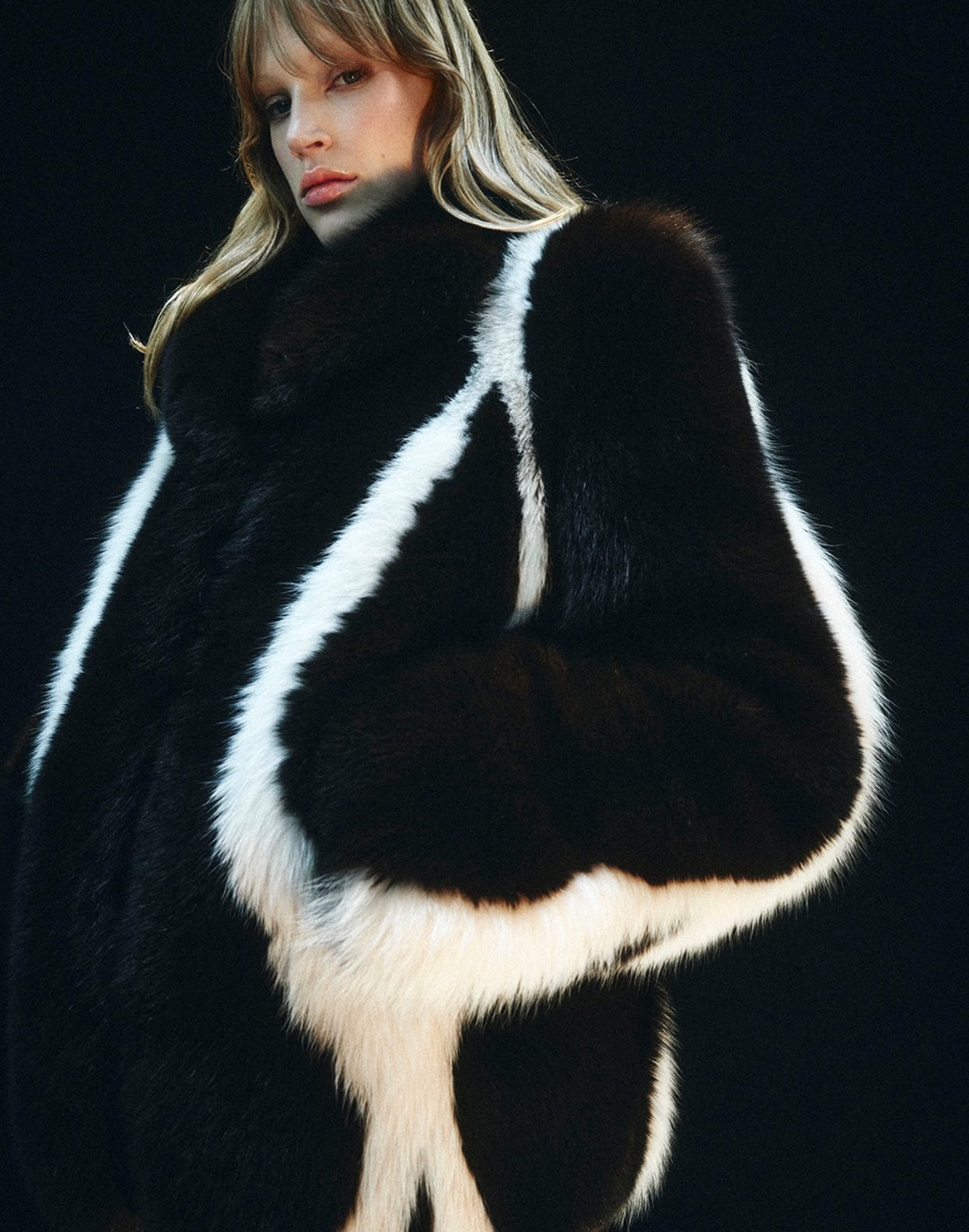
This collection begged you to reach out and touch it. Structural texture. FUR. Leather felt dense and substantial. Velvet was cut into hourglass gowns. There were raw edges left visible — selvage seams allowed to fringe slightly — which gave the tailoring a delicious, lived-in tension. You could feel the atelier training in it. Howie worked under Alber Elbaz; she understands how to build emotion through cut rather than BS embellishment.
What stood out most was how tactile everything felt. Satin caught the light, knits draped with a slight slouch against heavier outerwear, yum. Twinsets were curiously styled under leather, which could have skewed stuffy and uptown but instead felt cool. The collection felt warmer than past seasons. Maybe even cozy? And yes, it looks like we’re in for another year of tights as pants.
The shift is easy to clock from cerebral minimalism into something more physical. FFORME feels less theoretical and more embodied now. It’s still a disciplined brand, but the discipline now accommodates the body. Someone is listening.

At Heirlome, Stephanie continues to orbit heritage, but this season it felt more assured. The lace wasn’t fragile; high-necked blouses were cut with enough sharpness through the shoulder to keep them from drifting into costume. There were again skirts with a faint Edwardian lean, but the waistlines were clean. There was a standout plaid suit that would make any wearer the baddest bitch in the room and leather opera gloves with a swishy woven crop top that my friend immediately borrowed for an event.
Stephanie is iterating in a way that feels almost risk-averse. But what I appreciate about Heirlome right now is that they’re not drowning in reference. The fabrics do the talking. It reads as sentimental without being saccharine.
At Kallmeyer, the show hit at golden hour — that late-winter New York light that turns the skyline honeyed. As the sun dropped, a David Byrne cover of “Drivers License” began thumping through the venue, and I couldn’t help but let a little laugh escape at the humor of Daniella’s music choice. I wish I could explain the alchemy of that moment. It was melancholic and silly and serious and commercial and weird and hopeful at once.
Daniella sat me next to her mom. At the end of the show, when she came out for her bow, her mom began sobbing — not politely tearing up, but fully overcome. I lost it. Watching a woman watch her daughter stand in her power like that does something to you. It reframes the clothes and reminds you how personal these worlds are. You see the years behind the brands.
But sentimentality aside, these clothes were built to sell. I sat amongst buyers and head honchos from Net-a-Porter, Bergdorf’s, and other boldfaced retail names, and they were all nodding. Will they choose wisely?
If there was an undercurrent at KHAITE this season, it was Kennedy-adjacent in a way that felt almost too on the nose to be an accident. The room was full of that late-90s New York shorthand polish that reads expensive because it’s withholding. Then you looked to the front row, and it became literal: actress Sarah Pidgeon (Ryan Murphy’s Carolyn Bessette in Love Story) photographed alongside Cassandra Grey, wearing Carolyn Bessette’s actual 1998 Yohji Yamamoto suit. The suit itself has provenance — gifted to Grey years ago by Carole Radziwill — and the photo basically writes the whole thesis for you: Khaite as the modern vessel for that CBK restraint, updated for women who know what Instagram is. 
On the runway, Catherine Holstein leaned into the dark-romance side of her language, but still kept the clothes in that Khaite register where the sex appeal is controlled. ELLE described the show as built around “the crushing weight of words,” with cascading LED text and an audio track reading words alphabetically. That theme actually made sense of the clothes: authority, institutional dressing, a kind of armored poise. You saw high collars, military shoulders, gold cross chains, lace naked dresses, and those sharp little jolts of styling (argyle with opera gloves) that stuck the landing.
The bigger story, to me, is watching Catherine evolve into this designer who’s fully in command of a world. Early Khaite’s thesis was all about the young New York “cool girl”, whoever she is. Now Holstein’s building a dom-com universe without losing the clothes. Was it an audition for an even bigger stage? You could feel it. 
She’s also doing it while living a different life. Vogue has noted her two young children at home while she’s running shoots and building collections, and that context matters — not in a mommy-blog way, but because you can see the design getting more decisive. I’d venture to say a few dresses were pretty much “fuck you”.
Then we all ended up at Bemelmans, maybe a last chapter in the Kennedy Pinterest board of an evening. Khaite and Mytheresa hosted a post-show cocktail there (Hamilton Leithauser live at the Carlyle, Miller High Life pony bottles, the whole thing), and it had that old Manhattan glamour where everyone in attendance had a publicist. 
Khaite isn’t just a runway brand anymore. I think this was the season that affirms it as a cultural node. But even cultural nodes answer to customers. When the playlist cuts, when the influencers go home, when the ghosts evaporate — what’s left?
When you strip away all the glamour and artifice and the seating chart politics, and the piece is just hanging in your closet — what then? Then it has to hold the fuck up! It has to survive coffee, weather, meetings, dinners, LIFE! And if it doesn’t — if it only worked under runway lights or on starved, waifish bodies — then we should stop rewarding it.
I’m here to tell you what I saw from within the room. That’s part of my job. But the truth is, what matters more happens outside the room.
It happens in the dressing room. In the mirror at home. In the moment when you reach for something on a random Tuesday and decide whether it makes you feel hot. It happens when you pull a coat off the hanger on a cold day, and it either justifies its existence, or it doesn’t.
Runways are theater. Closets are reality. And I’m not sure we need all the theater when reality is this sobering. If you don’t have something meaningful to say, don’t cast thirty models and stage a show to not say it. Do a brand activation or some other soulless thing engineered for screens, and please, do not invite me. I want to see more stuff like the crystalline dress at Khaite that made me elbow my friend in the ribs and say, “You’re wearing that to my wedding.”
The brands can stage whatever spectacle they want for 400 insiders. The verdict comes later, when you zip it up alone. Does everything I saw this week deserve people’s time, body, and money? No. And it’s fair for all of us to vote with our dollar when it doesn’t. But the good shit? That’s why I’m here. And with David Byrne still thumping in my head, I’m making my shopping list.
I may never wear much that you write about but I have always loved fashion, looking at it and reading about it. My goodness, Jess. Bravo. This was the best essay I have EVER read about it in my many years on Earth.
I cried reading that you cried next to Daniella Kallmayer's mom crying